



How a Mid-Office Connects Your GDS, CRS, CRM, and Accounting System
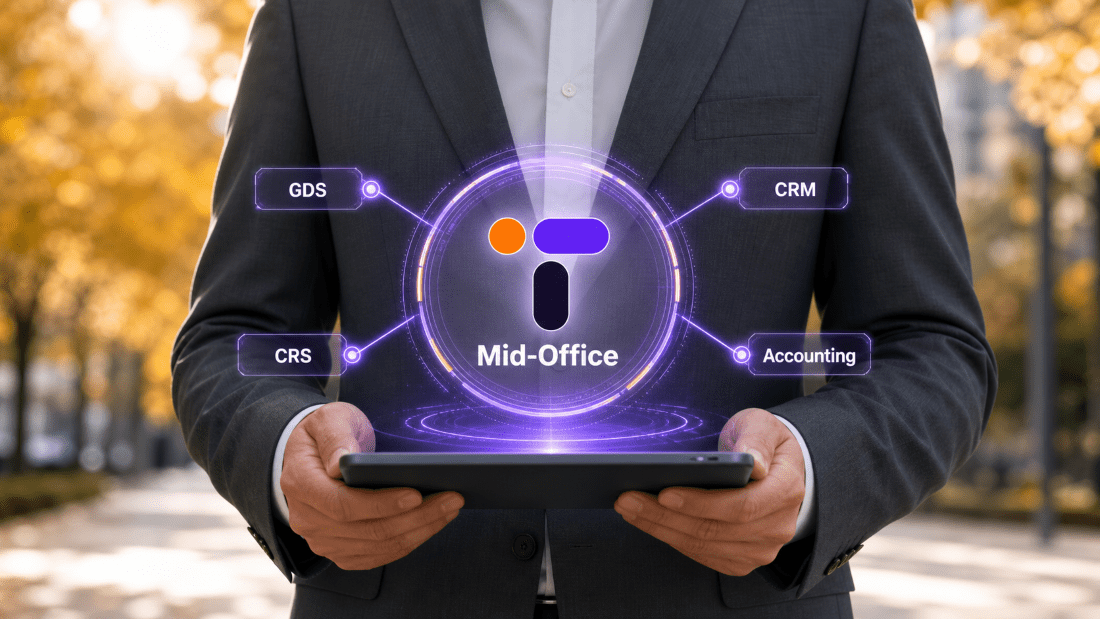
Travel agencies run on data that’s scattered across systems that were never designed to talk to each other. A booking confirms in the GDS, a customer’s preferences live in the CRM, an invoice needs to land in accounting, and somewhere in between, someone is copying numbers from one screen to another. A mid-office is the layer built to close that gap – and understanding how it actually moves data between your GDS, CRS, CRM, and accounting system is the first step to deciding whether your agency needs one.
Key Takeaways
- Data fragmentation happens because GDS, CRM, and accounting platforms are built as standalone systems, not as a connected stack – travel agencies fill the gap with manual re-entry, which is slow and error-prone.
- Travel agency technology runs as a three-layer architecture: the front office sells (websites, OTAs, GDS, CRS), the mid-office executes and controls (processes, validates, and modifies bookings), and the back office settles (financial settlement and accounting).
- The moment a booking is confirmed in the GDS, the mid-office captures the PNR and structures it into usable records without an agent re-typing anything.
- CRM data flows through the mid-office so service teams have full booking and customer history in one place, instead of toggling between tabs.
- Accounting sync turns confirmed, validated bookings into invoices and ledger entries automatically, which is what actually shortens end-of-month reconciliation.
Why Travel Agencies Run Into Data Fragmentation Problems
The root cause is simple: most travel agencies operate on a patchwork of systems that were each built to do one job well, not to share data with the systems around them. A GDS travel agent books through Amadeus, Sabre, or Travelport. The agency tracks customers and follow-ups in a separate travel agency CRM. Invoices, supplier payments, and commissions get logged in a travel agency accounting software platform. None of these were designed with the others in mind, so the connective tissue between them has to come from somewhere – and that somewhere is usually a person.
In practice, that means an agent finishing a booking in the GDS, then manually keying the same passenger, fare, and itinerary details into the CRM so the service team has visibility. Finance then re-enters those same figures into the accounting system to generate an invoice or log a supplier payable. Some agencies lean on shared spreadsheets as a stopgap, copying booking references back and forth between teams. Others rely on end-of-day exports, where someone pulls a report from the GDS and reconciles it against the CRM and accounting records by hand, catching mismatches days after they happened.
These manual steps aren’t just tedious, they’re where data fragmentation actually causes damage. A fare correction made in the GDS doesn’t automatically update the CRM, so a service agent might quote a customer’s outdated pricing. A canceled booking that isn’t manually reflected in accounting can result in an invoice going out for a trip that no longer exists. Each handoff between systems is a point where a number can get mistyped, a record can fall out of sync, or a step can simply get missed during a busy week. The more bookings an agency processes, the more those small errors compound into real reconciliation headaches and customer-facing mistakes.
Where the Mid-Office Sits in Your Technology Stack
Industry frameworks consistently describe travel agency technology as a three-layer architecture, and it’s the clearest way to place a mid-office correctly. The front office is where bookings are created: websites, OTAs, your GDS, and your CRS (central reservation system). The mid-office is where those bookings are processed, validated, modified, and operationalized. The back office consolidates the agency’s financial activity: settlement and accounting.
Put simply, the front office sells, the mid-office executes and controls, and the back office settles. That middle step is doing real work, not just relaying data untouched from one system to the next. When a booking lands from the GDS or CRS, the mid-office applies pricing logic where relevant, handles modifications and supplier communication, and generates the documents tied to the booking – confirmations, vouchers, invoices. In Travel Booster Mid-Office system, only once a booking has been processed does its financial detail move on; all supplier reconciliation is handled within the system itself, and journal entries covering the accounting activity are then exported to the back office accounting software. This way, the data that reaches accounting tends to be far cleaner than data pulled straight from a GDS export.
Without this layer, agencies are left bridging the front and back office manually; re-entering data, checking fares by hand, chasing down document generation which is exactly where delays, errors, and revenue leakage creep in. This is the core function of mid-office automation: it’s not purely a booking engine and it’s not purely a finance platform – it’s the operational hub that processes, validates, and controls bookings between the two. That said, through its connections to content providers, it also serves travel agents as a fully capable booking system. For tour operators, the mid-office goes further still, functioning as a complete platform for building, configuring, managing, and selling tourism products. . For a broader look at how these pieces fit together as a system, see Travel Booster’s explainer on travel agency software and how an automated travel system is structured end to end.
How the GDS Connection Works
From an operational standpoint, the GDS connection is where the data flow begins. Travel agents use the GDS primarily to book flights, though hotels can be booked there as well. Every booking is managed under a PNR (passenger name record), a single record containing the full booking detail: passenger information, itinerary, fare basis, ticketing deadlines, and any remarks the agent has added. Ticketing itself is handled in the GDS, with the resulting data then passed through to the mid-office. In general, the flow runs in one direction: GDS into the Mid-office system.
Travel agencies working with Travel Booster Mid-Office – The PNR is seamlessly transferred in full to the mid-office automatically, without manual re-entry. Once it arrives, the business rules configured in the system such as: commission structures, pricing rules, agency-specific workflow logic; are applied to the booking. The one exception to the GDS-to-Mid-Office direction is at the point of PNR creation: passenger details can be pulled from Travel Booster and inserted directly into the new PNR, including information beyond the name such as phone number and frequent flyer number, ensuring the GDS record is populated accurately from the start. Agencies using a CRS (central reservation system) alongside the GDS bring the same flow to non-GDS inventory as well – for more on how that fits together, see Travel Booster’s explainer on the inventory system in travel.
How CRM Data Connects Through the Mid-Office
Once booking data has been captured and structured, the mid-office routes the relevant pieces to the CRM acting as a comprehensive repository, collecting and saving customer data and history for future use by the travel agent. This isn’t a full dump of GDS data, it’s the specific information a service or sales team actually needs: customer contact details, itinerary summary, booking status, payment status, and any special requests or notes tied to the trip.
What this enables in practice is straightforward but valuable. A service agent fielding a customer call can see the full, current booking record without switching screens or asking another department to check the GDS. If a customer calls about a delayed flight or a change request, the agent already has accurate, up-to-date details in front of them instead of working from a record that might be a day or two stale. All past booking history exists on the Mid-Office system, which supports better follow-up on repeat customers and renewal opportunities without manual data pulls.
Notes or preferences an agent logs in the travel agency system: a customer’s preferred seat, a known allergy, a loyalty number – can be referenced the next time a booking comes through, so the front-office team isn’t starting from zero with returning customers. For agencies evaluating their CRM setup, Travel Booster’s roundup of the best CRM tools for travel agencies is a useful next read.
How Accounting Sync Works in Practice
The accounting side is where the mid-office’s value becomes most visible, because this is the step that used to take the most manual labor. By the time a booking’s financial details reach this stage, the mid-office has already validated them and applied any pricing or commission rules – so what lands in accounting isn’t a raw GDS export, it’s a clean, checked record: fare amount, taxes, fees, commission, and supplier payable.
In plain terms, here’s what that looks like day to day: a booking confirms, and instead of a finance team member pulling that booking up separately and typing the numbers into an invoice, the mid-office generates the invoice automatically and passes the data to the accounting platform. The commission gets logged against the right booking, and the supplier payable is recorded without anyone touching a calculator or a spreadsheet. If a booking is later modified or canceled, that update flows through the same path, so the accounting record adjusts instead of sitting outdated until someone catches the discrepancy manually.
This is also where reconciliation gets faster. All reconciliation processes against GDS, suppliers, airlines, individual customers, and corporate clients, including payments and receipts, are handled directly within Travel Booster. The accounting software then receives journal entries covering all financial activity, rather than raw data that needs manual matching. In effect, Travel Booster functions as a financial auxiliary system to the accounting software, doing the reconciliation work upstream so the accounting platform receives clean, organized records ready to post. Agencies looking to compare platforms for this part of the stack can review Travel Booster’s guide to the best accounting software for travel agencies.
FAQ
What happens if the GDS and mid-office fall out of sync?
If the connection drops or a sync fails, downstream records stop reflecting current bookings. Most mid-office platforms flag failed syncs so staff can intervene, but agencies should monitor this actively, since an undetected gap can mean inaccurate customer records or missed invoicing for a period of time.
Does a mid-office replace a CRM for travel agencies?
While a mid-office is not a direct replacement for a dedicated CRM, Travel Booster’s mid-office system plays an active role in managing customer data. It centralizes customer profiles, booking history, and preferences within comprehensive travel files, ensuring your team has immediate access to critical guest information. The CRM continues to be the primary hub for managing long-term sales pipelines and complex relationship marketing, but the mid-office ensures this data is always populated with accurate, real-time booking details and history without manual entry.
How does mid-office accounting integration reduce end-of-month reconciliation time?
Travel Booster automatically generates journal entries for all accounting documents: invoices, vouchers, payments, receipts, tax invoices, and more. Then, it exports them to the accounting software without manual entry. Critically, all reconciliation processes, including supplier reconciliation, BSP, ARC, and customer reconciliation, are handled directly within Travel Booster. That means finance teams aren’t assembling data from multiple sources at month-end, the reconciliation work happens in the system where the booking data already lives, and only the finalized journal entries move out to accounting.
- Share:


Let's go for a journey
More Resources
-
Blog
-
Blog
-
News