



Can AI Replace a Travel Mid-Office? What It Can and Can’t Automate

Key Takeaways
- Most of what looks like “AI” in a travel agency mid office today is actually rules-based automation: deterministic code that matches supplier invoices, flags currency discrepancies, and drafts confirmations, not a model making a judgment call.
- AI cannot replace the judgment calls that sit at the center of mid-office work: resolving supplier disputes, interpreting ambiguous contract terms, and making exception decisions that carry financial or client consequences.
- Without a mid-office system underneath it, automation has no single source of truth to reconcile against, which makes errors harder to trace back to their origin, not easier.
- The practical path is a split: automate the high-volume, rules-based mid-office tasks first, and keep human review on anything involving supplier negotiation, contract exceptions, or client-facing financial decisions.
- Travel Booster combines rules-based automation, not AI models, with a centralized mid-office data model, so automated actions stay traceable and reversible rather than becoming a second black box.
Every travel agency is being asked, in one form or another, whether AI can replace the mid-office team. It’s a reasonable question, but the honest starting point is that most of what already runs on autopilot in a modern mid-office isn’t AI at all. It’s rules-based automation, deterministic code that matches invoices, updates records, and generates documents the same way every time. Mid-office operations, the work that happens between a confirmed booking and a closed invoice, involve more judgment than either “AI” or “automation” suggests from a distance. This piece breaks down what mid-office operations actually cover, where rules-based automation and genuine AI each fit today, what neither can replace, and how to sequence automation so it reduces errors instead of hiding them.
What a Mid-Office Does Between Booking and Invoice
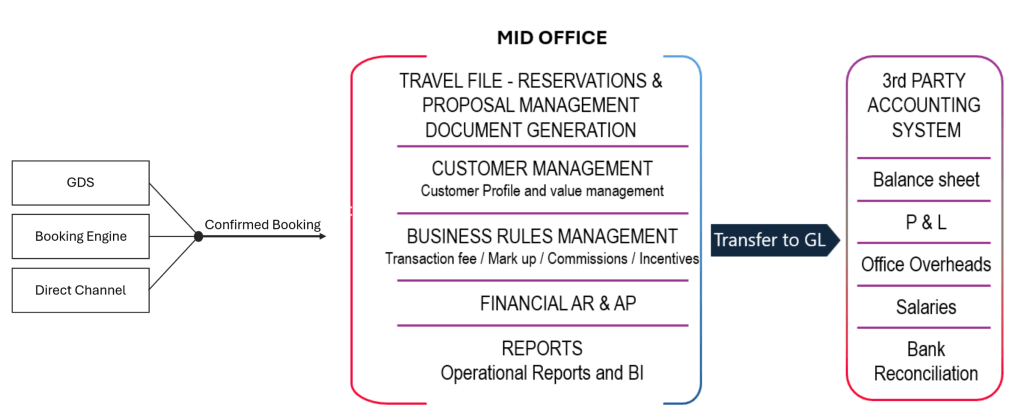
The mid-office is the operational layer that sits between the booking (made through a GDS, booking engine, or direct channel) and the final invoice. It’s where a confirmed reservation becomes a fully reconciled, accurately priced, and properly documented transaction.
Concretely, mid-office work includes:
- Supplier reconciliation. Matching what was booked against what the supplier invoiced, including handling discrepancies like Airline Debit Memos (ADM) and Airline Credit Memos (ACM).
- Financial processing. Accounts receivable and payable, currency conversion, commission tracking, and general ledger export.
- Documentation. Vouchers, itineraries, and confirmations, often across multiple languages and formats depending on the client and market.
- Exception handling. Cancellations, date changes, refunds, and disputes that don’t follow the standard booking-to-invoice path.
- Data consolidation. Pulling booking, supplier, and client information from GDS, CRS, and CRM systems into one coherent operational view, then exporting reconciled financial data out to the agency’s accounting system rather than pulling from it. How Mid-Office Connects Your GDS, CRS, CRM and Accounting System walks through how these connections actually work day to day.
None of this is visible to the traveler, but all of it determines whether an agency’s margin numbers are accurate and whether its books close cleanly at the end of the month. It’s also exactly the layer where manual work has historically piled up, which is why it’s the first place agencies look when they ask what AI can take off their plate.
What AI Automates Well in Mid-Office Operations Today
This is where the AI-versus-automation distinction matters most. Most of the tasks people point to as “AI in the travel mid-office” are rules-based automation: deterministic code that follows the same logic every time, not a model making a judgment call. Genuine AI, in the machine-learning sense, plays a narrower role today, mainly in scanning large volumes of transactions for patterns a human would take too long to spot by hand. Both are valuable. Neither should be oversold, and adoption is moving fast enough that the distinction is worth getting right: Phocuswright’s 2026 travel research found that more than 60% of travel businesses are already experimenting with or scaling agentic AI, though only 6% report it running at full scale. Most agencies are still deciding where automation belongs, not whether it belongs at all.
Here’s what’s handling each task today, and what still needs a person:
| Task | How it’s handled today | What still needs a human |
| Invoice and supplier matching | Rules-based automation compares invoice line items to the booking record and flags mismatches | Approving exceptions and resolving disputed charges |
| Document generation (vouchers, itineraries, confirmations) | Automated, template-driven generation from booking data | Non-standard or custom document requests |
| Anomaly detection | Pattern-based flagging of transactions that fall outside expected norms | Deciding what the anomaly means and how to resolve it |
| Routine communication | Automated, template-based confirmations and reminders | Sensitive or non-standard client communication |
| Currency and rate updates | Automated synchronization against source rates | Validating rates in disputed or edge-case contracts |
Invoice and supplier matching. Rules-based automation compares a supplier invoice against the original booking record and flags discrepancies, such as an unexpected surcharge or a currency conversion mismatch, far faster than a human doing the same comparison manually.
Document generation. Drafting confirmations, vouchers, and standard itinerary documents from booking data is a well-defined, structured task that rules-based automation handles reliably, freeing staff from repetitive formatting and data entry.
Anomaly detection. This is one of the few places genuine AI, not just rules-based automation, adds distinct value. It’s well suited to scanning large volumes of transactions and surfacing the ones that don’t fit expected patterns, an unusually large refund, a duplicate charge, a rate that doesn’t match the contracted price, so a human can review the specific exceptions rather than every transaction.
Routine communication. Booking confirmations, payment reminders, and status updates that follow a predictable template are a natural fit for automation, reducing the volume of manual outbound communication mid-office staff previously handled one at a time.
Currency and rate updates. Automatic currency updates and rate synchronization reduce the manual work of keeping pricing accurate across markets, a task that’s mechanical in nature but was previously time-consuming to do by hand.
What these tasks have in common is that they’re bounded: there’s a correct answer, defined by the data, and the system, whether rules-based automation or genuine AI, is checking or generating against that defined standard. For a closer look at how agencies sequence these in practice, see 8 Time-Saving Mid-Office Workflows.
What AI Cannot Replace and Why
Where mid-office work stops being bounded, AI’s reliability drops. This is where human judgment remains essential.
Supplier dispute resolution. When a supplier and an agency disagree on a charge, resolving it involves negotiation, relationship context, and judgment calls about which battles are worth fighting.
AI can flag the discrepancy. It can’t negotiate the resolution.
Ambiguous contract interpretation. Supplier contracts often include cancellation policies, allotment terms, and pricing tiers that require interpretation in edge cases the contract didn’t explicitly anticipate.
This is a judgment task, not a pattern-matching task.
Exception decisions with financial consequence. Deciding whether to absorb a cost, pass it to the client, or push back on a supplier is a business decision that depends on the client relationship, the agency’s margin position, and factors that aren’t fully captured in the transaction data.
Client-facing sensitive situations. Refunds tied to emergencies, complaints, or unusual circumstances require empathy and discretion that automated systems aren’t equipped to apply appropriately.
The common thread: AI cannot replace decisions that require weighing context outside the transaction itself: judgment, relationships, and consequences. These are the exact things that make mid-office work skilled work rather than clerical work.
Why AI Without a Mid-Office System Makes Errors Harder to Trace
This is the part of the AI conversation that gets skipped most often: automation applied on top of a fragmented tech stack doesn’t just fail to help. It can actively make errors harder to find.
If a travel agency layers AI tools onto disconnected systems, a GDS here, a spreadsheet there, a separate accounting tool, each AI tool is working from a partial, disconnected view of the transaction. When something goes wrong, tracing the error means checking every system the AI touched, plus the AI’s own output, with no single source of truth to reconcile against. How Mid-Office Automation Cuts Booking Errors shows what that error-tracing problem looks like in practice, and how a centralized reconciliation layer closes it.
A centralized mid-office system solves this by giving automation, whether AI-driven or rules-based, one consistent data model to work from and write back to. When an anomaly is flagged, it’s traceable to a specific booking, supplier, and transaction record, not scattered across systems that don’t talk to each other. This lines up with what McKinsey’s research on AI in the travel industry has found: travel companies that address digital and analytics opportunities holistically across the organization, rather than as a bolt-on, see a measurably better return, with McKinsey estimating a 15 to 25 percent earnings improvement for companies that do this well. A patchwork of point solutions tends to cap the return automation can deliver. This is also why “AI in travel mid-office” and “mid-office system” aren’t competing investments; automation is only as reliable as the data infrastructure underneath it.
A Practical Split: Which Mid-Office Tasks to Automate First
For agencies deciding where to start, and where this fits into the broader AI shift across the travel industry, the practical split looks like this:
Automate first (high-volume, rules-based, low ambiguity)
- Supplier invoice matching and reconciliation
- Standard document and voucher generation
- Currency and rate updates
- Routine confirmation and reminder communications
- Anomaly flagging for human review
Keep human-led (judgment-based, relationship-dependent, high consequence)
- Supplier dispute negotiation
- Contract interpretation in edge cases
- Exception decisions involving cost absorption or client credits
- Sensitive client communications
- Strategic decisions about supplier relationships and terms
The sequencing matters as much as the split itself. Agencies that automate the high-volume tasks first free up staff time and attention for the judgment-based work, which is exactly where mid-office expertise adds the most value. Agencies that try to automate judgment-based work too early tend to end up with more manual correction work, not less.
How Travel Booster Combines Automation and Human Control in the Mid-Office
Travel Booster’s approach treats automation and human control as complementary, not competing, an approach that runs through the entire ERP platform, not just the mid-office module. Its automation, includes automated end to end workflow tickets , refunds , ADM/ACM processing, automatic currency updates, automatic financial document creations , reconciliation process and automatic export data to GL, is rules-based rather than AI-driven, and runs against a centralized mid-office data model rather than a patchwork of disconnected tools. That means every automated action, from a flagged discrepancy to a generated voucher and invoice , is tied back to a single, traceable booking record.
Real-time business intelligence dashboards give mid-office , management and finance teams visibility into what’s being automated and what’s being flagged for review, so human staff can focus their attention on exceptions and judgment calls rather than re-checking routine transactions. The supplier commission module and unified Travel Files List give teams a centralized, customizable view of operations, which is what makes it possible to hand off high-volume tasks to automation without losing the ability to trace, audit, or reverse individual actions.
The result is a mid-office where rules-based automation, not AI guesswork, absorbs the repetitive load, and human staff retain full control over the decisions that require it. That’s the split worth getting right before deciding what to hand off to a system and what to keep with your team.
FAQ
Can AI fully automate a travel agency’s mid-office?
No. Much of what handles high-volume mid-office tasks today, like invoice matching and document generation, is rules-based automation rather than AI; true AI adds the most value in tasks like anomaly detection. Either way, none of it replaces judgment-based work such as supplier dispute resolution, contract interpretation, and exception decisions with financial or client consequences.
What mid-office tasks should travel agencies automate first?
Start with supplier invoice reconciliation, standard document and voucher generation, currency and rate updates, and routine confirmation communications. These are high-volume and rules-based, which makes them reliable candidates for automation with immediate time savings.
Is AI automation safe to use without a mid-office system in place?
It’s risky. Without a centralized mid-office system providing one source of truth, AI tools working across disconnected systems produce errors that are harder to trace back to their origin, since there’s no single record to reconcile the automated action against.
Does AI in travel mid-office operations reduce the need for skilled staff?
It shifts the work rather than eliminating it. Automation absorbs repetitive tasks, which frees skilled mid-office staff to focus on supplier negotiation, exception handling, and client-facing decisions, the work that actually requires their expertise and judgment.
Can an AI agent replace a mid-office system for a small travel agency?
No, and the smaller the agency, the more this matters. A small agency has fewer staff to catch what an AI agent misses, and no separate team to build the data infrastructure underneath it. An AI agent still needs a mid-office system, even a lightweight one, to reconcile against; without it, a small agency ends up doing the same manual checking it was trying to automate away.
How should an agency measure whether mid-office automation is actually working?
Track three numbers: hours of manual reconciliation work removed per week, the error or exception rate before and after automation, and how many flagged anomalies actually needed human intervention versus how many were false positives. Falling exceptions and rare false positives mean the automation is tuned correctly; staff still double-checking everything means it isn’t.
- Share:


Let's go for a journey
More Resources
-
Blog
-
Blog
-
News